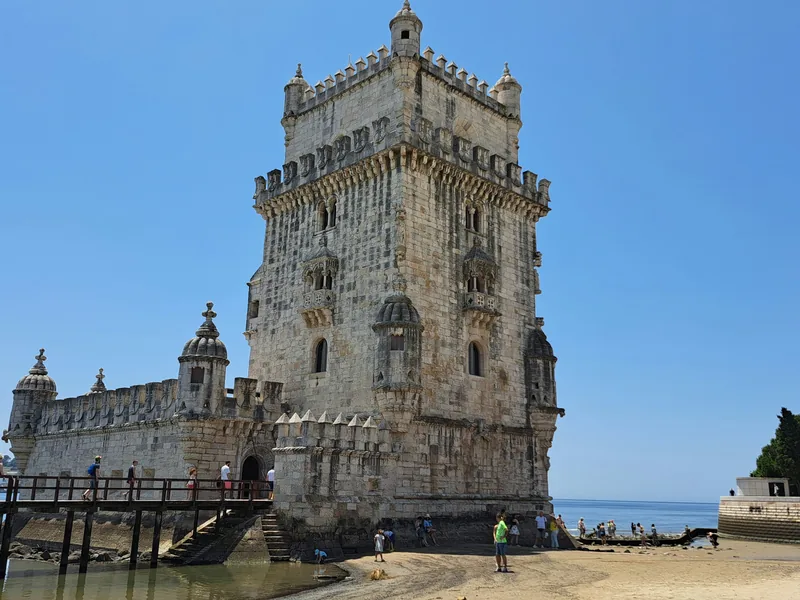
Lisbon's 500-year-old guardian of the Tagus.
Built 1514-1519 as Manuel I's fortified gateway to Portugal's age of empire — UNESCO World Heritage 1983, capacity-capped at 900 visitors a day since May 2026.
Get your Belém Tower ticket- UNESCO World Heritage Site, 1983 (jointly with Mosteiro dos Jerónimos)
- 1514-1519 Built under King Manuel I as a fortified gateway
- 900 / day Daily capacity since May 2026 — book ahead
- 30 m Tower height, 4 storeys, terrace views over the Tagus
Tickets and tours for Torre de Belém
Compare the best-rated ways to visit, check live availability and book in a few taps.
- Top pick
Lisbon: Belém Tower Entry Ticket
Standard entry to Belém Tower: the bastion, the Governor's and King's Chambers, the chapel and the rooftop terrace over the Tagus.
From US$17Check availability ↗ Lisbon: Belém Tower Entry & Audio Guide
Entry to Belém Tower with a self-guided audio tour on your phone, to hear the tower's story floor by floor.
From US$23Check availability ↗Lisbon: Belém Tower Guided Tour with Ticket
A guided visit of Belém Tower with the entry ticket included, led by a local guide.
From US$43Check availability ↗
More things to do nearby
About Torre de Belém
Torre de Belém is one of the most photographed monuments in Portugal — a four-storey Manueline limestone tower built 1514-1519 by architect Francisco de Arruda, commissioned by King Manuel I as a fortified gateway protecting the mouth of the Tagus and a symbol of Portugal's emerging maritime empire. From this stretch of river, Vasco da Gama set out for India in 1497 and returned in 1499; Pedro Álvares Cabral departed for Brazil in 1500; Bartolomeu Dias rounded the Cape of Good Hope. The tower watched all of it.
Four storeys plus the terrace. The bastion (rondela) at water level held the cannon battery. The governor's hall, royal hall, and audience chamber are stacked above, each with armillary spheres, Crosses of Christ, and rope-stone Manueline carvings on the window frames. The chapel is tucked into the third floor. The terrace gives one of the best views in Lisbon: the Padrão dos Descobrimentos monument 500m away, the 25 de Abril Bridge, and the Cristo Rei statue on the south bank. Plan 45-60 minutes inside.
Belém Tower and Mosteiro dos Jerónimos were inscribed by UNESCO in 1983 as a single joint World Heritage Site — they are historically inseparable. Both commissioned by Manuel I from the same wealth that flowed in from the maritime expeditions. Both completed in the early 1500s. Both designed in the Manueline style that exists nowhere else. They are 10 minutes' walk apart. Visit them on the same morning and you have the most complete day in Portuguese imperial history available anywhere.
Practical information
- Address
- Av. Brasília, 1400-038 Lisboa, Portugal
- Getting there
- Tram 15E from Praça da Figueira (~25 min). Or take the Cascais line train from Cais do Sodré to Belém station (7 min) — the tower is a 10-min walk along the riverside from there.
- Opening hours
- Tuesday–Sunday 9:30–17:30 (last entry 17:00). Closed Mondays. Closed 1 January, Easter Sunday, 1 May, 13 June (Lisbon's Saint Anthony Day), 25 December.
- Best time to visit
- Arrive at the 9:30 opening or after 16:00. Midday (11:30–14:30) is the cruise-ship window — every coach in Belém arrives in that block. Mornings are quieter and the light on the Tagus is at its best.
- Free entry
- Children up to 12, disabled visitors with companion, ICOM card holders, Lisbon residents on Sundays before 14:00.
Plan your visit
Practical guides written by our travel team
How to Get to Belém Tower from Central Lisbon
The scenic tram 15E, the faster Cascais-line train, the riverside walk, and how to fold the tower into a half-day taking in Jerónimos and the Pastéis de Belém.
Belém Tower and Jerónimos Monastery in One Day
Why the two monuments are one UNESCO site, how to sequence them to beat the queues, and what a combined visit reveals about Portugal's imperial golden age.
The Manueline Style of Belém Tower: Reading the Symbolism in Stone
Armillary spheres, the Cross of the Order of Christ, the rhinoceros gargoyle and the Moorish watchtowers — what the carvings on Belém Tower actually mean.
Frequently asked
What's the difference between this and buying at the gate?
Two things: (1) you skip the ticket-office queue, which in peak season wraps around the bastion and can be 30-60 minutes; (2) you secure a slot for a fixed-capacity attraction — at the new 900/day cap (since May 2026), busy days sell out by mid-morning and walk-ups get turned away.
What time should I arrive?
Arrive 15 minutes before your timed-entry slot. The Avenida Brasília gate is on the riverside; look for the skip-the-line lane (it's marked, separate from the standard queue). Photo ID may be requested for reduced/family tickets.
Is the tower accessible?
Partially. The bastion (ground floor) is wheelchair-accessible. The four upper storeys are reached only by a narrow spiral staircase from the 16th century — no lift, steep steps, low headroom in places. We'll happily issue your booking but advise mobility-limited visitors that the upper storeys are not adapted.
What is Belém Tower?
Belém Tower, known in Portuguese as the Torre de Belém and historically as the Tower of St Vincent, is a fortified tower on the north bank of the Tagus estuary in the Belém district of Lisbon, Portugal. It was built between 1514 and 1519 by the architect Francisco de Arruda, commissioned by King Manuel I to defend the entrance to Lisbon's harbour and serve as a ceremonial gateway for ships of the Age of Discovery. Standing about 30 metres tall across four storeys plus a rooftop terrace, it is carved from lioz, a creamy local limestone, in the ornate Manueline style unique to Portugal. UNESCO inscribed it on the World Heritage List in 1983, jointly with the nearby Jerónimos Monastery. Notable features include a hexagonal river bastion, an arcaded Renaissance loggia, armillary spheres and a celebrated stone rhinoceros.
How do I get to Belém Tower?
Belém Tower sits about six kilometres west of central Lisbon, on the Tagus waterfront in the Belém district, and is straightforward to reach by public transport. The most scenic option is tram 15E, which runs from Praça da Figueira and Praça do Comércio along the riverfront and takes roughly 25 minutes; alight at the Largo da Princesa or Belém stop, then walk a few minutes south towards the river. Alternatively, the Cascais-line train from Cais do Sodré station reaches Belém station in about seven minutes, from where the tower is a 10-to-15-minute walk west along the waterfront promenade. Several bus routes, including the 714, 727, 728 and 751, also serve the Belém area near Avenida Brasília. Driving is discouraged: waterfront parking is limited and fills early on peak-season mornings, so public transport is usually the faster, easier choice.
How does booking work on this site?
This site is an independent visitor guide to Torre de Belém. When you choose a ticket or tour, you book it directly with GetYourGuide, which takes the payment, issues the ticket and handles any changes or cancellations. We may earn a commission when you book, at no extra cost to you.